


People start Substack publications for many reasons. I usually start one when my mind has become so chaotic with thoughts on a certain topic that even private externalization of these thoughts isn’t enough, and so I need an audience to help me both filter what is worth saying and to keep me intellectually honest.
This publication—The Third Brain—will be specifically about how to use AI for theoretical physics research, and more broadly about how to incorporate AI into your life to reach new heights while preserving your mind and your humanity.
My journey with AI over the last several years
I don’t know about you, but my journey with AI over the last several years has been complicated. Even putting aside all the other complex issues (environmental impact, what are they trained on, …) and just focusing on what it feels like to be a user.
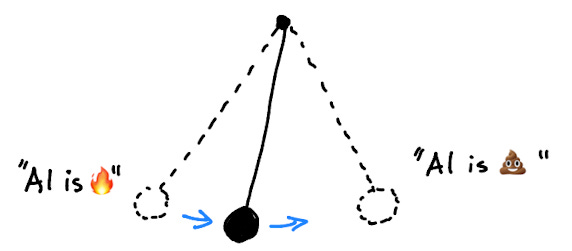
I keep having images of a pendulum oscillating between “omg AI is incredible” and “omg AI is destroying our brains and our humanity”:
Or maybe it’s more like a Bloch vector rotating between the basis and superposition states:
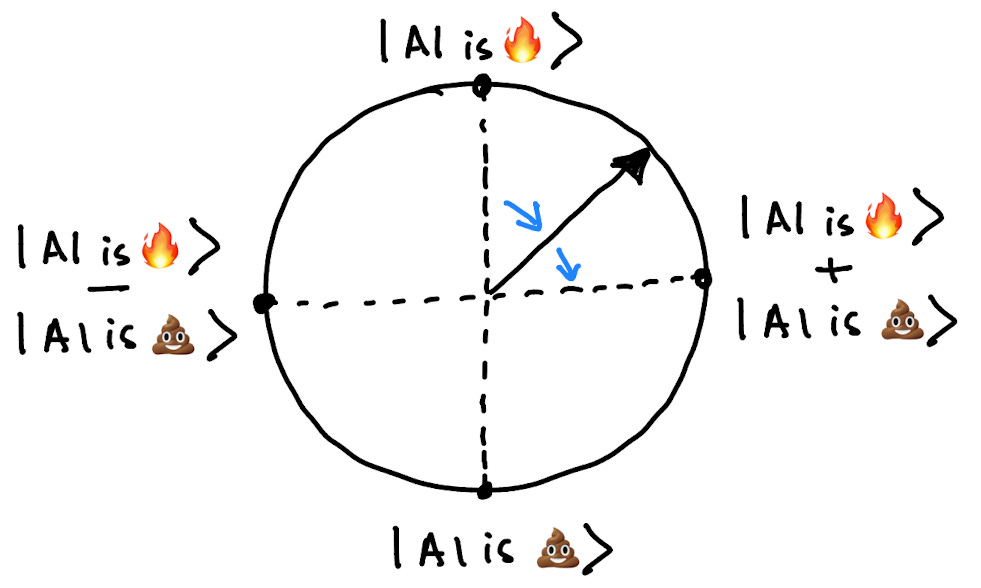
More recently, I’ve been finding myself in the superpositions states. But let’s start at the begining.
The pendulum swings for the first time: AI is fun and then it’s not
Like most people, I started with ChatGPT in around 2022. I don’t think I used it for anything particularly serious in that first year or two.
Then the buzz with agents started. I dove into AI-assisted coding around the end of 2024 (click here to read about me figuring out how to use Cursor and Lovable in real time). With those tools, I built a bunch of physics-related web apps. It was fun.


Then I lost interest, for reasons I can’t quite recall. Maybe I found it annoying that github kept sending me messages about security vulnerabilities and I felt out of my depth (update: they are now fixed!). Maybe I found the apps I built a bit pointless. Maybe it was frustrating running out of tokens. Something turned me off.
The pendulum swings back: Claude Code is 🔥
My interest picked up again toward the end of 2025, a few months after Claude Code came out. One of my clients kept insisting that I need to look at AI-assisted coding again. That things had changed. That it’s really quite amazing now. So I did, and it was.
And so with Claude Code, I started developing a product to complement my consulting practice. It was a visualization tool for exploring the quantum ecosystem.
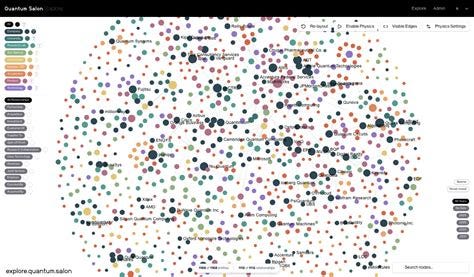
But I was soon met with the standard challenge of scaling. The tool worked really well at small scale, but I felt like I didn’t have the software engineering expertise to build it out to the scale that I wanted. I thought about whether it made sense to hire a software developer to help take it to the next level.
Then it swings back again: where is my moat?
Unfortunately, at around that time, I saw that another company posted the same kind of visualization to their website. It made me quite depressed.
Did they copy me? I don’t know. But on some level, it doesn’t really matter. It made me realize that if I can use AI to build something like this, then so can anyone else. If you want a moat you need to have something that is not easy to acquire and reproduce. In my case, that was my expertise in communciation and quantum science and technology.
So I decided to double down on figuring out how to use the tools to support my consulting practice—where I did have a moat—directly.
The first superposition state: AI for work but pen-and-paper for fun (Mind Club)
But this came with its own challenges, this time existential. While I was becoming more efficient and effective in my consulting practice, I started to feel like something was missing. I was noticing a decoupling between the outcomes and the experience of work: the outcomes could be very good but the experience of creating them felt more hollow.
And after winding down development of the ecosystem app, I felt like I needed a new project. From this, and the thoughts above, spawned the idea of Mind Club.
It started as an event series where people would get together and do pen-and-paper exercises—in math, science, logic, and language—without the use of modern technology (no phones, no AI). This seemed to strike a chord and there was a lot of enthusiasm about it. (For more about the origin story, check out this amazing article covering Mind Club by Alex Kinsella).
But over time the events morphed from “let’s sit down and do homework” to “let’s unplug and hang out”, in response to direct and indirect feedback from participants.


It eventually became clear to me that what people really wanted was to connect with like-minded people, not do problem sets (except for Andrew 😆). I empathized with this very much, but at the same time I knew that I wasn’t the right person to enable that. I still had scars around the emotional burnout I experienced while running Academics in the Wild. I didn’t want to run a community, I just wanted to give people homework. So after five or so months, I put Mind Club on hiatus.
The second superposition state: the cloister and starship model
But something interesting came out of the Mind Club experiment. One of the events I held was on the topic of quantum mechanics.
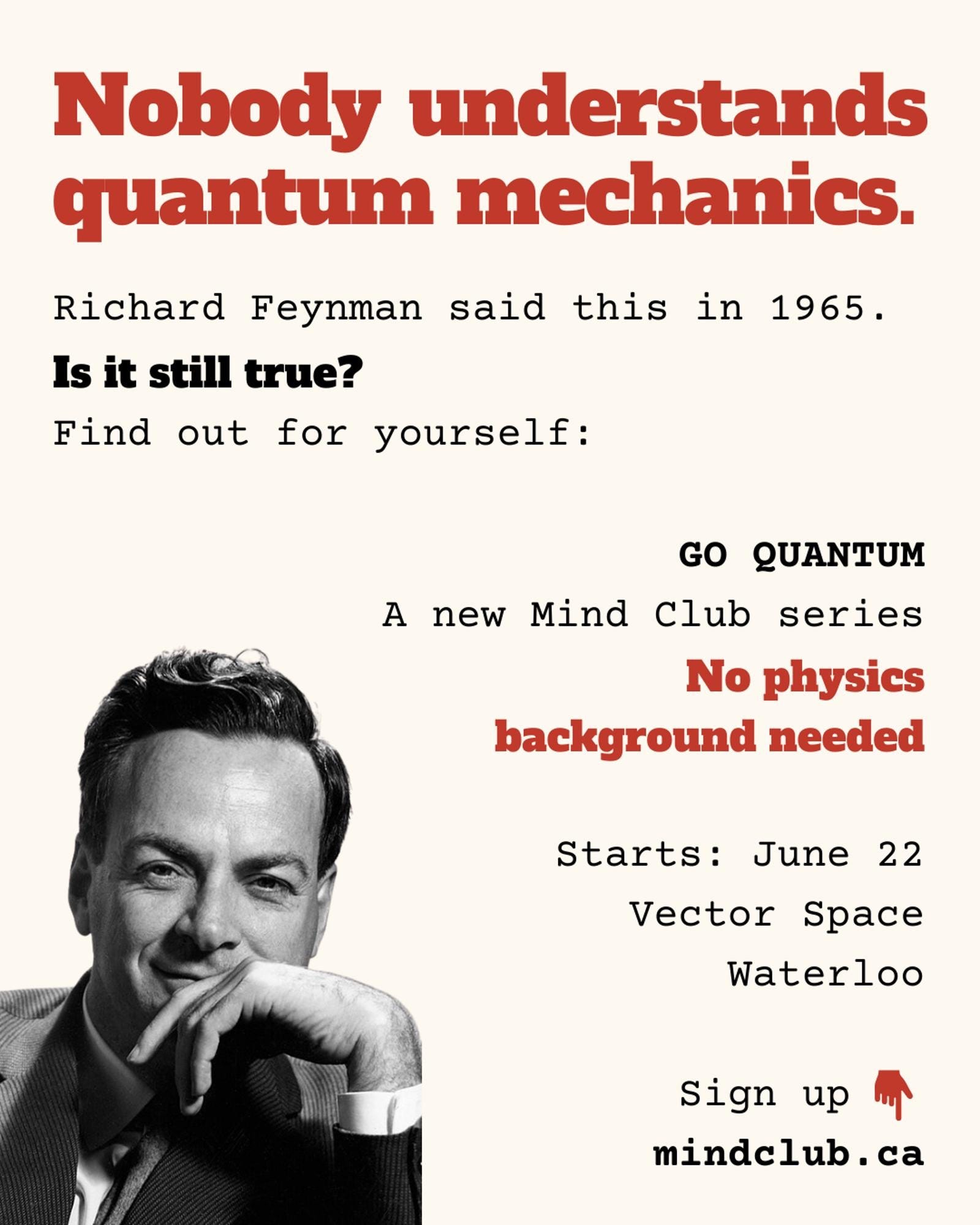
Preparing the problem sets for that event rekindled my enthusiasm for quantum foundations and for returning to physics research.
You may recall that the top item on my list of things I wanted to pursue since starting my business in 2024 was “Do research in quantum foundations”. This had been difficult to put into practice because starting a business is all consuming. But by now, things were chugging along well, and I realized that the time I was able to put into Mind Club could be used for getting back into research more seriously instead.
I had also started to get the sense that the original premise for Mind Club was flawed. Of course, it makes sense that when you first start using AI, you use it to modify existing workflows to make them more efficient. After a while, this can feel mind-numbing and lead to dissilusionment. But the solution isn’t to force yourself to do things the old fashioned way in an articifical setting. It’s to still use old fashioned methods in real settings, when they make sense, while at the same time figure out how to do new kinds of fulfilling and creative with AI.1
So I adopted an approach to working that resembled what I later found out to be called the Cloister and Starship Model. In my cloister, I would have quarantined time using traditional methods of work and study where I would read books and printed papers, and make notes with pen and paper. In my starship, I would explore how to use the latest AI technologies to learn and do things in new ways previously not possible for me.
I was applying this to both physics research and my consulting work.
The Third Brain
Becoming an independent researcher was something I had dreamed about—and have been working towards—for at least the last decade (this is a story I will one day share in full). But in reality, even the most independent researchers need a community of other researchers, and some kind of institutional support, even if it isn’t in the form of a salary.
I have the enormous privelidge of being an affiliate member at the Perimeter Institute here in Waterloo. For the most part, this relationship has taken the form of participating in career mentorship and quantum industry events, but it also meant that I could participate in research activities if I wanted to. So I started attending the research meetings at the quantum foundations group.
This coincided with the group having discussions on how to use AI tools more effectively for research. I realized I had a lot to say on the topic. Not just on how to use the tools themselves, but also about the larger workflows that would be needed to incorporate these tools in the process of collaborative research. And so a couple of weeks ago, I gave the following talk to the group.
I then held a workshop where the group connected their AI assistants to github and started working on their third brain.
This made me realise that it might be a good time to put together a course on agentic AI for theoretical physics research (if you’re interested, join the waitlist here). One of the things I plan to do over the next while is talk to researchers who have been using these tools to try and get a lay of the land (if you’re interested in talking, send me an email).
In the mean time, so many other related things were happening around me. All of the recent LLM-assisted results in the field of mathematics. My Builders Club friend’s startup launching an AI scientist called Primus. My occasional podcast co-host, Tobias Osborne, leading the way in thought leadership on the topic of LLMs for natural sciences.2
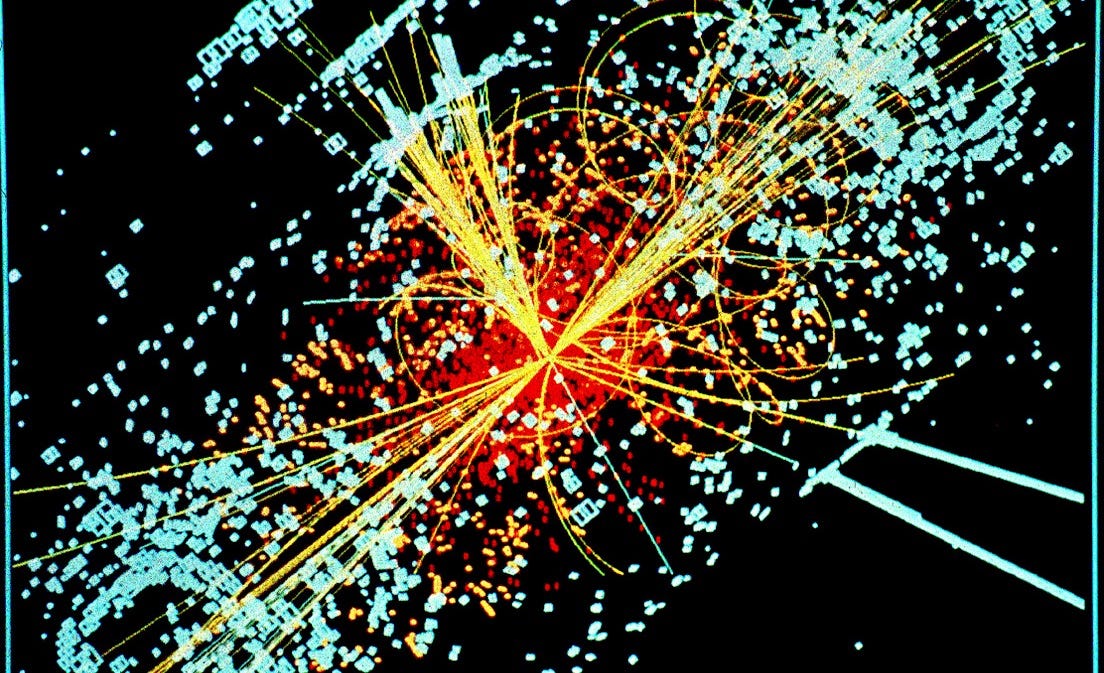
It was a lot to process and my (first) brain started to feel like this:

Working in public again
So I realized that in order to make sense of all of it, I needed to write, and to write in public. Which is why I’m starting this Substack.
If you would like to join me as I put all of my thoughts in order, I would love to have you along for the ride!
Postscript: what about Quantum Salon?
It’s going strong!
After two years, I think I’ve finally reached a really good place with it. The work is rewarding, it supports my lifestyle, and gives me time to work on my passion projects, which was the goal from the start.
But some people have asked, because I don’t post much about it any more.
One reason is that posting is time consuming on the strategic side, and it doesn’t really help with my specific business. Quantum startup founders and professors don’t really sit around on LinkedIn reading about communication frameworks. Over time I realized that my clients either come from word-of-mouth or when they do find me online, it’s because they saw me doing something else interesting that wasn’t talking about communications.
The other reason, on the organic side, is that a lot of the stuff I do for my clients, that I would normally want to share with people because its cool, is confidential. So it’s a bit hard to talk about it.
But if you want to know more about what shape that work takes, I recently redid the website to give a better idea of what I actually do.
No AI was used in writing this post. It was a complete brain dump. All emdashes are mine.
(But that doesn’t mean I’m completely against using AI to assist writing, as long as it is high quality and not slop.)
I don’t think I have a concrete answer for what that looks like yet, but I recently gave a friend the following analogy.
Imagine you live on a farm a hundred years ago and you make all your family’s clothes by hand with a needle and thread. And you take some joy and pleasure in the craft behind this.
Then you get a sewing machine and it makes everything more efficient, and maybe a little better, but it’s not very joyful anymore. You spend more time debugging the machine rather than the craft of sewing. If all you use the machine for is doing what you did before you had the machine, it is depressing.
But now you see that the machine gives you some capabilities you didn’t have before. It is much stronger than your fingers. You can now imagine making a saddle for your horse or curtains for the house. You never had to think about how to make these things before because you didn’t have the capability. But now you can learn and be creative in this new way.
Also, since you are faster with the machine, you don’t have to focus on just the everyday clothes for your family, but maybe you can think about making a Sunday party dress for your daughter, which you never had the time to do before, so you can explore this kind of creativity.
And even if you miss the hand work, there are some things you can’t do with the machine anyway. Like making delicate doilies to put on the table.
So once you figure out how to use the tool, you can be creative in a new way you couldn’t before.
(And with this analogy, Mind Club's answer was: with this time saved, just spend your time sewing things by hand that no one needs 😆)
We’ll be recording the next episode soon!